The Empty Diagonal · Lozère and Aveyron · gorge
The Gorges du Tarn From the Bottom
The viaduct gets all the attention. The gorge beneath it is another country.
Filed at
3A few people, no crowd.
The viaduct gets all the attention. The gorge beneath it is another country.
Go Down, Not Over
The Millau Viaduct is one of the genuine engineering spectacles of modern France — a deck of steel riding above the clouds on piers reaching almost 245 metres, with masts that rise higher than the Eiffel Tower, carrying the A75 autoroute across the Tarn valley in a matter of seconds. Most drivers feel something, briefly, and then it is behind them. Almost none of them descend.
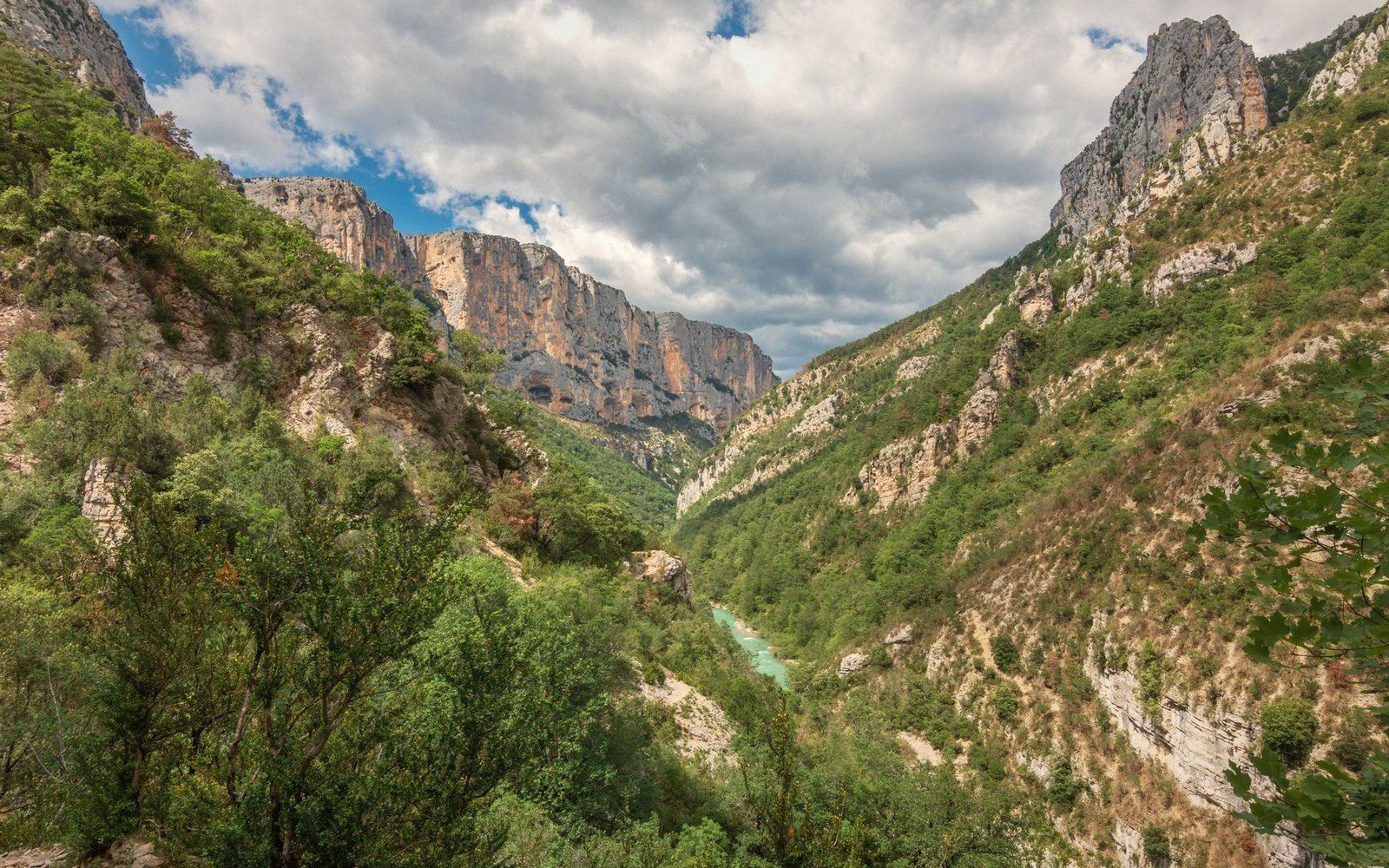
The Gorges du Tarn run roughly seventy kilometres between the Causse de Sauveterre to the north and the Causse Méjean to the south, cutting through limestone several hundred metres deep. The walls are vertical in places, amber and grey and rust-coloured depending on the hour, narrowing the sky to a strip. What the viaduct crosses in about a minute takes the better part of a day at river level, and that is precisely the argument for going down.
The road along the gorge floor — the D907 bis on the Tarn's north bank — is not a scenic drive in the brochure sense. It is tight, occasionally alarming, and in summer it fills with campervans whose drivers quickly regret their choices at the passing places. The payoff is scale. Photographs taken from the causse rim above always flatten the depth; the gorge reads as dramatic landscape. From the bottom, with those same walls rising on both sides and the river green and fast beside you, it reads as containment. You are inside the thing, not looking at it.
The villages along the floor — Sainte-Énimie, La Malène, Les Vignes — are worth the stops, not as destinations but as evidence. Sainte-Énimie, a medieval village built into the cliff face, demonstrates how communities once organised themselves around the only flat land available. La Malène is the traditional departure point for flat-bottomed boat descents of the narrowest passage, the Détroit — the narrows — where the walls press close enough to shade the river for much of the day.
The kayak option is the honest one. On the water you surrender the ability to stop and linger, but you also stop fighting for road position with coaches. The current does the work and the gorge does the rest.
Coming up out of the valley at either end involves a long switchback climb back onto the causse — the high limestone plateau — and the sudden return of sky. That re-emergence clarifies what you spent the previous hours inside. The viaduct, if you cross it afterwards, looks different: less like a triumph over the landscape, more like a polite refusal to engage with it.
What the terrain actually involves4 entries
- Gorges du Tarnlimestone canyon roughly seventy kilometres long, cutting between two causses (high plateaus) of the Massif Central
- Causse Méjeanthe high plateau south of the gorge, one of the Grands Causses
- Détroitthe narrows; the tightest passage of the gorge, best experienced at water level
- D907 bisthe road running along the gorge floor on the north bank of the Tarn; narrow, slow, and correct
On the water you surrender the ability to stop and linger, but you also stop fighting for road position with coaches.