The Cities · Rhône · city
Lyon: The City Between Two Rivers
The peninsula between the Saône and the Rhône divides itself into zones that most visitors never cross — here is what each quarter is actually for.
Filed at
7Busy — ten minutes of walking gets you out of it.
The peninsula between the Saône and the Rhône divides itself into zones that most visitors never cross — here is what each quarter is actually for.
The Shape Comes First
Lyon is not a city you can read from a map until you understand that it runs between two rivers, on a narrow tongue of land called the Presqu'île — literally "almost an island" — with a steep Roman hill to the west and a longer, lower hill to the northeast. The rivers converge at the city's southern tip, near Perrache station, and fan apart again as you move north. Everything about how Lyon works — its commerce, its politics, its restaurant life, its class geography — follows that physical frame.
Most visitors arrive at Part-Dieu, the main rail hub on the east bank of the Rhône, and migrate west toward the Presqu'île without ever returning to the eastern bank. They miss roughly half the city. A more useful approach is to treat Lyon as five distinct zones and move through them in sequence, because each one is doing something different.
The five zones5 entries
- Presqu'îlethe central peninsula; civic, commercial, restaurant-dense
- Vieux-LyonRenaissance west bank; traboules, silk-trade history, summer crowds
- FourvièreRoman hill to the west; theatres, basilica, city views
- La Croix-Roussenorthern hill; canut (silk-weaver) history, independent character, Saturday market
- East bank / Part-Dieu and Guillotièreinfrastructure, transport hub, the city's most diverse neighbourhood
Five Zones, One City
The Presqu'île is where the city performs itself. Place Bellecour, the vast red-gravelled square near its centre, is the reference point most Lyonnais use when giving directions; it also marks where the Presqu'île widens enough to accommodate major civic and cultural buildings, and the covered market hall of Les Halles Paul Bocuse, rebuilt in Bocuse's time and still the best indoor food market in France for sheer density of serious produce. North of Bellecour, the streets tighten and rise toward Terreaux, where the seventeenth-century hôtel de ville faces Bartholdi's monumental fountain. The Presqu'île's restaurants cluster on side streets rather than the main arteries, and quality drops significantly on the obvious pedestrian corridors: the rule holds here as elsewhere.
Vieux-Lyon sits on the west bank of the Saône, directly below Fourvière hill, and is older than the Presqu'île in the sense that matters: this was the city's commercial core during the Renaissance, when Lyon was one of the great banking and silk-trading centres of Europe. The traboules — covered passageways running through building blocks from street to courtyard to street — were used by silk workers to move bolts of cloth without exposing them to rain. Several dozen remain accessible, the most visited running through the Saint-Jean district. The architecture is genuine; the souvenir economy around it is suffocating in summer. Off-season, or early on a weekday morning, Vieux-Lyon recovers some composure.
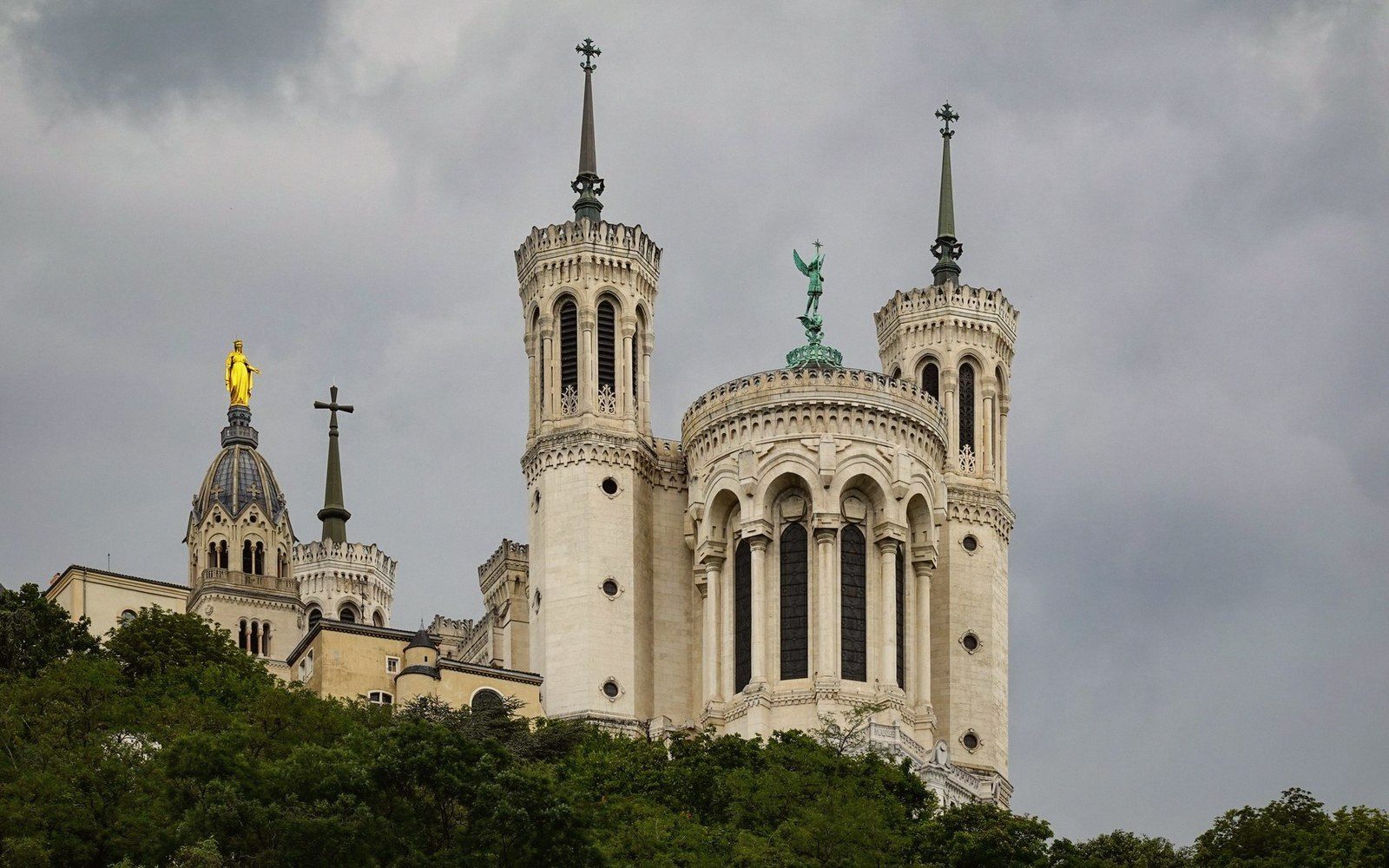
Above it, the Fourvière hill is worth the climb for two reasons: the Roman theatres, which are the largest and best-preserved in France outside Provence, and the view east across the entire Presqu'île to the Rhône and beyond. The nineteenth-century basilica that crowns the hill is architecturally exuberant in a way that divides opinion and commands the skyline from almost anywhere in the city. A funicular rises from the Saint-Jean metro station if you prefer not to walk.
La Croix-Rousse occupies the lower northern hill, above the point where the two rivers draw closest together. This was the quartier of the canuts — the silk weavers who operated the mechanical Jacquard looms that made Lyon's textile industry dominant through much of the nineteenth century. The buildings are taller here than elsewhere, with unusually high ceilings designed to accommodate the looms. The canuts led two major uprisings, in 1831 and 1834, and the hill still carries that history in its bone structure — independent-minded, slightly apart from the city below it. Today it runs to organic food shops, independent bookshops, and a Saturday morning market on the main boulevard that is less theatrical and more functional than the ones on the Presqu'île.
The east bank — the quarter around Part-Dieu and beyond — is what the city's residents actually use for infrastructure: the main station, the major shopping centre, the hospital complex, the business district. It is not scenic and nobody is pretending otherwise, but the neighbourhood of Guillotière, just south of where the Rhône bends, is the city's most genuinely mixed district: North African, West African, Southeast Asian traders alongside long-established working-class streets, with a covered market and a cluster of Vietnamese and Chinese restaurants that are among the best-value eating in the city.
Terms worth knowing4 entries
- Presqu'île"almost an island"; the long peninsula between the two rivers
- Traboulecovered internal passageway through a city block, characteristic of Vieux-Lyon and Croix-Rousse
- Canutthe silk weavers of Croix-Rousse; gave the hill its social character
- Bouchontraditional Lyonnais bistro; offal-heavy, convivial, frequently imitated
What the City Asks of You
Lyon has a functioning metro and a dense tram network, but the terrain — the two hills, the two river crossings — means walking is genuinely the fastest way to understand it. The city is compact enough that you can move from the Roman theatres on Fourvière to a bouchon lunch on the Presqu'île to the Croix-Rousse market in a single half-day without feeling rushed. Bouchons, the traditional Lyonnais bistros that serve offal-forward, generous cooking at long communal tables, have become sufficiently iconic to attract imitation; the real ones are identifiable less by signage than by the absence of a translated menu in the window.
The city repays a return visit better than most. The first trip fills in the geography; the second is when you actually use it.
The architecture is genuine; the souvenir economy around it is suffocating in summer.