The Cities · Bouches-du-Rhône · city
Marseille Past the Vieux-Port
The harbour is the postcard. The city is everything behind it.
Filed at
7Busy — ten minutes of walking gets you out of it.
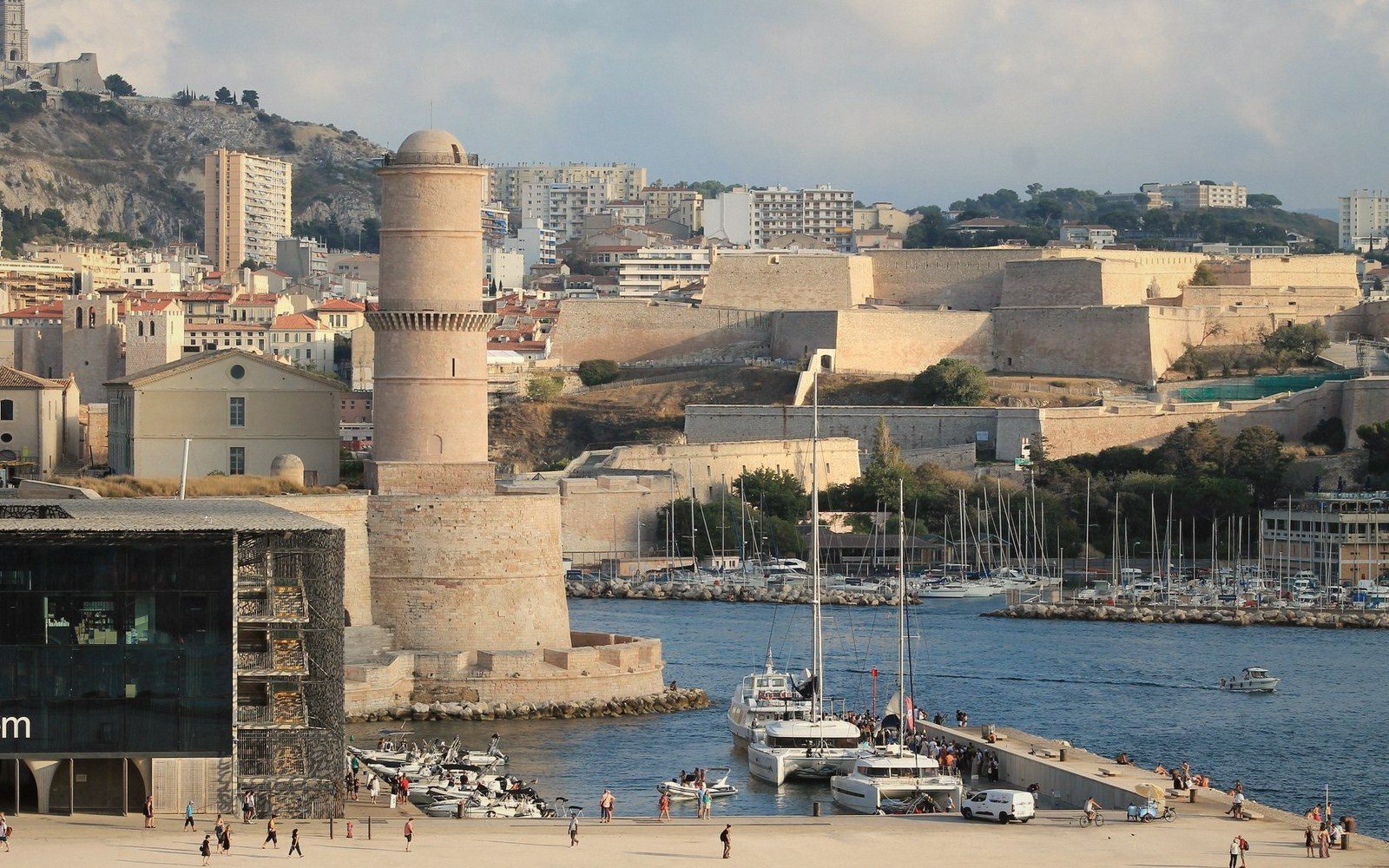
The harbour is the postcard. The city is everything behind it.
The Frame You Arrived With
Every visitor to Marseille gets the same first image: the Vieux-Port at golden hour, fishing boats rocking on black water, the Fort Saint-Jean anchoring the northern entrance and the Basilique Notre-Dame de la Garde watching from the hill above. It is, genuinely, a fine sight. It is also the smallest version of the city.
Marseille is France's second-largest city by population and its oldest by foundation — the Greeks arrived at this harbour around 600 BCE and called it Massalia. That depth of occupation has left a city that grew outward in layers, absorbing waves of Ligurian, Italian, Armenian, North African, Comorian and Vietnamese settlement, each one depositing a neighbourhood that has not quite dissolved into the next. The Vieux-Port is the focal point for visitors precisely because it is manageable, photogenic and contained. The city's actual character requires leaving it.
ChronologyChronology
- c. 600 BCEGreek settlers found Massalia at the site of the modern Vieux-Port
- 17th centuryCentre de la Vieille Charité built as a hospice; chapel designed by Pierre Puget
- 19th–20th centurysuccessive waves of Mediterranean, North African and Indian Ocean immigration reshape the northern arrondissements
- 2012Parc National des Calanques established, one of the few national parks in France that begins within a city boundary
Le Panier and What Comes After
The first step most people take is uphill into Le Panier, the old quartier that sits above the northern quay. It is Marseille's oldest residential district, a compact tangle of staircases and painted façades that has gentrified selectively — a ceramic workshop beside a bar that has not changed since the 1980s, a social housing block abutting a gallery. The Centre de la Vieille Charité, a seventeenth-century hospice built around a Baroque chapel designed by Pierre Puget, now contains two museums and a courtyard that earns the detour on its own terms.
But Le Panier is also where the tourist circuit tends to stop, and that is where the more interesting walk begins. North of it, through the districts roughly grouped under the shorthand of the northern arrondissements — the 13th, 14th, 15th and 16th — the city looks nothing like the harbour photographs. The architecture here runs from Haussmann-era apartment blocks to postwar social housing projects, some of the largest in France, intercut with neighbourhood markets operating in Darija, Comorian French and Somali. These are not quarters that need a visitor's approval. They have their own internal logic, their own food economy, their own rhythms. A foreigner walking through is simply a foreigner walking through. That absence of performance is, in itself, worth something.
The fish market on the Quai des Belges by the port is famous and real but smaller than its reputation. The actual fish trade happens earlier and further north, at the wholesale market near l'Estaque, the former fishing village absorbed into the city's western edge, where Cézanne and Braque both worked and where the industrial port infrastructure now shares the coastline with a clutch of restaurants serving fried fish in the Provençal manner.
Terms worth knowing7 entries
- calanquea narrow coastal inlet cut into limestone, specific to this stretch of the Mediterranean coastline
- garriguelow aromatic scrubland of the Mediterranean basin; highly flammable in dry season
- panissefried chickpea flour cake, a Genoese import embedded in Marseille street food
- navetteelongated orange-blossom biscuit associated with the Abbaye Saint-Victor; sold year-round
- bouillabaissesaffron-based fish stew originating in Marseille; the genuine version specifies local rockfish and a strict order of service
- Le PanierMarseille's oldest residential quarter, above the northern quay of the Vieux-Port
- DarijaMoroccan Arabic, one of several languages in common use in the northern arrondissements
The Calanques Approach
South of the Vieux-Port, the city does something improbable: it runs out of city and into limestone. The Parc National des Calanques — the coastal national park established in 2012 — begins within the municipal boundary, an extraordinary adjacency of urban density and near-vertical white rock dropping into fjord-like inlets. The calanques, those narrow creek-inlets carved by ancient rivers and drowned by rising sea levels, can be reached on foot from the city's southern arrondissements. The approach from the Luminy campus or from the bus terminus at La Gineste puts you on the GR98 trail before the day visitors arrive by boat.
The walk to Calanque de Morgiou or Sugiton requires nothing technical but does require genuine footwear and enough water. In July and August the access is often restricted by fire risk — the garrigue scrubland burns easily and the park authority enforces closures. This is not a bureaucratic inconvenience but a rational response to a real danger. Go in May, or in October, when the light on the limestone is hard and clear and the crowds are absent.
Marseille has a reputation for hostility that is partly earned and largely exaggerated.
How the City Feels
Marseille has a reputation for hostility that is partly earned and largely exaggerated. It is a working port city with a complex relationship to its own diversity, and it does not soften itself for visitors. The food culture is genuine and unmarketed: panisse (fried chickpea flour, a Genoese inheritance), navettes (orange-blossom biscuits associated with the abbey of Saint-Victor), and bouillabaisse, the saffron fish stew that exists here in versions that bear no resemblance to the tourist-menu simulacra. The real article is expensive, slow and served with considerable ceremony in restaurants that have been doing it the same way for decades.
The city rewards visitors who give it time and direction rather than expectation. Come for the harbour view if you want it. Then turn your back to the water and walk north, or south into the rock. That is where Marseille is.