The Coast · Alpes-Maritimes · coast
Nice Without Waiting for the Light to Change
The Promenade des Anglais is extraordinary and exhausting in equal measure. Here is how to read the city's seafront honestly.
Filed at
9A queue is part of the visit.
The Promenade des Anglais is extraordinary and exhausting in equal measure. Here is how to read the city's seafront honestly.
The Famous Strip and What Surrounds It
The Promenade des Anglais earns its reputation. The arc of the Baie des Anges is genuinely grand — the light off the water in the afternoon is not a cliché so much as a fact of physics, the way the Mediterranean fills and flattens everything. Walk the full length in the right conditions and you understand immediately why nineteenth-century visitors from northern Europe treated the place as a revelation.
What they did not have is the four lanes of traffic that now run the length of it. The promenade is wide, but the road is always present — audible, visible, felt — and in summer the pavement fills with the particular density of people who are walking slowly because they have nowhere specific to go. The experience is better in the early morning, when the light is low and the crowds are thin, or off-season, when the city remembers it has a population rather than a footfall count.
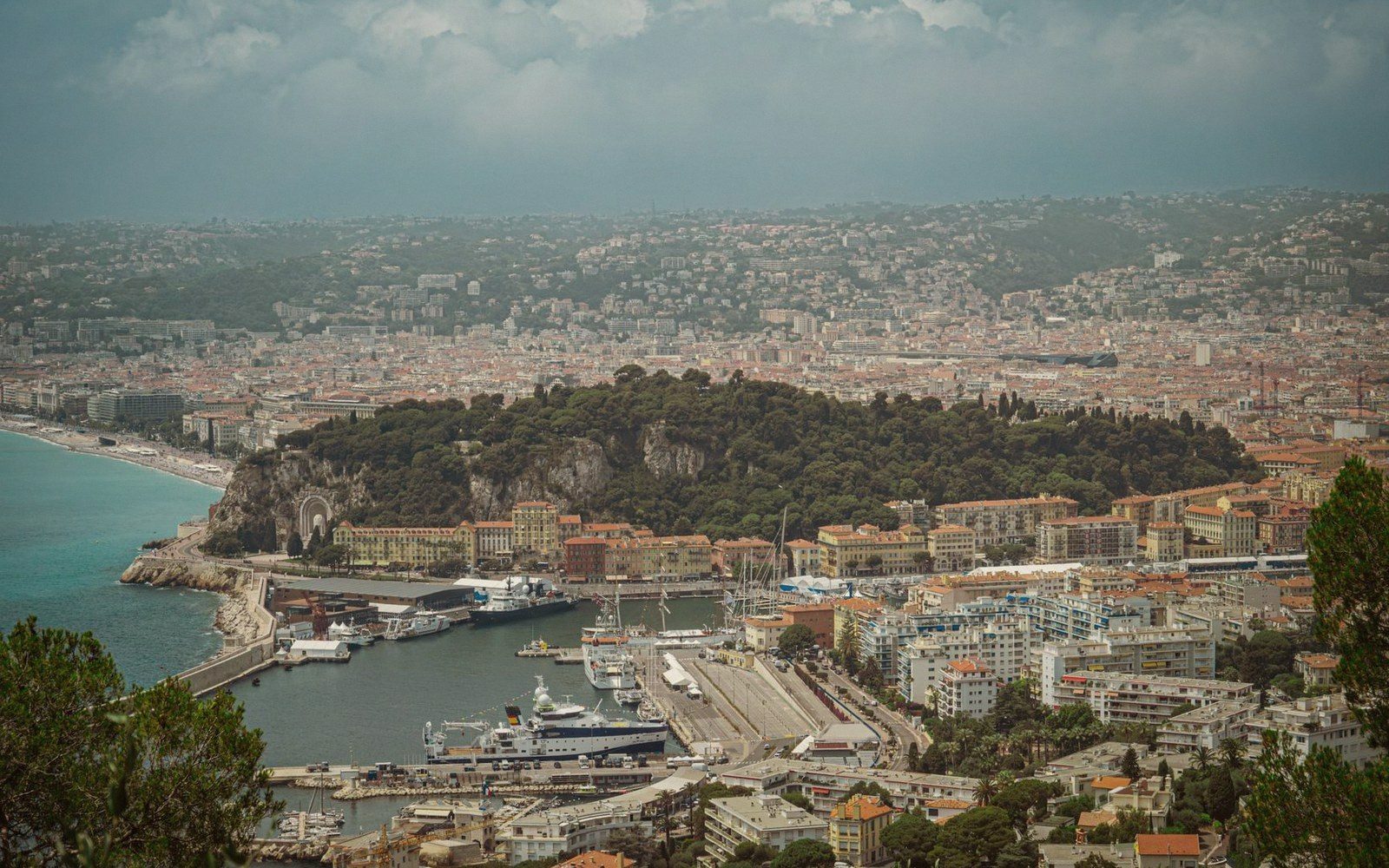
The mistake most visitors make is treating the promenade as the whole seafront story. It is not. East of the Opéra and the Cours Saleya — the broad open-air market square that functions as the social hinge of the old town — the character of the waterfront changes quickly. The Quai des États-Unis curves toward the base of the Colline du Château, the hill at the eastern end of the bay, and the crowds thin perceptibly within a few hundred metres. By the time you reach the foot of the castle hill itself, you are in a different city: quieter, older in feel, the buildings pressing closer to the water.
The Colline du Château rewards the climb. There is a lift if you want it, but the path up through terraced gardens earns you a reading of the whole bay that the promenade does not offer — the arc of it visible at once, the water greener and more varied than it appears from sea level. The castle itself was demolished in the early eighteenth century; what you get now is the prospect, which is the better inheritance anyway.
North of the hill, the Cimiez district — uphill, residential, built around a Roman arena and a Matisse museum — represents the other version of Nice entirely: the one not organised around the seafront at all. Neither beats the promenade for sheer scale. Both beat it for breathing room.
The light really is that good. It just does not require you to stand still and wait for it.
What to see versus what to skip5 entries
- Promenade des Anglaisthe long seafront boulevard; best value early morning or out of season
- Cours Saleyathe market square in the old town; the social centre between old town and sea
- Quai des États-Unisquieter eastern continuation of the waterfront, where crowds thin
- Colline du Châteauthe hill at the bay's eastern end; lift available; the best full-bay view in Nice
- Cimiezuphill residential district; Roman arena, Matisse museum, no seafront pressure
The mistake most visitors make is treating the promenade as the whole seafront story.