The Coast · Atlantic seaboard · road
The Atlantic Coast: What Changes as You Go South
From the Loire estuary to the Basque coast, France's Atlantic shore is not one thing — it shifts in landscape, architecture, light and atmosphere across four hundred kilometres of driving that most people skip in favour of the autoroute.
Filed at
4A few people, no crowd.
From the Loire estuary to the Basque coast, France's Atlantic shore is not one thing — it shifts in landscape, architecture, light and atmosphere across four hundred kilometres of driving that most people skip in favour of the autoroute.
Where the Loire Lets Go
The Atlantic coast of France begins, in any useful sense, where the Loire exhausts itself into a wide, silt-clouded estuary west of Nantes. The river has been enormous for hundreds of kilometres, and here it loses its argument with the sea in a slow, ambiguous way — the water is neither fresh nor salt for a long stretch, the banks are lined with marsh grass and rusting lock gates, and the light has that particular pewter quality that the Loire valley keeps even on clear days. Saint-Nazaire sits on the north bank in a way that flatters nobody in the tourist brochures, but it is genuinely worth a pause: the shipyard cranes are still working, the Second World War submarine base survives in concrete so dense that bombing failed to damage it, and the bridge across the estuary is one of the longer road bridges in France. Cross it heading south and you have made the commitment.
The coast immediately south of the Loire mouth is the Pays de la Loire giving way to the Vendée — a word that carries political weight in France (it was the region of violent counter-revolutionary uprising in the 1790s) but to a visitor registers mainly as a landscape of flat farmland set back from long sandy beaches, with low dunes and pine plantations providing thin cover. The architecture here is the architecture of the French summer — white rendered houses with blue shutters, holiday camps whose striped awnings are visible from the road, markets that operate on a seasonal logic that makes them disappear in October. The sea is Atlantic in its swell and temperature, but the vibe is still distinctly domestic, a French family holiday coast that has been functioning reliably since the railway reached it in the nineteenth century.
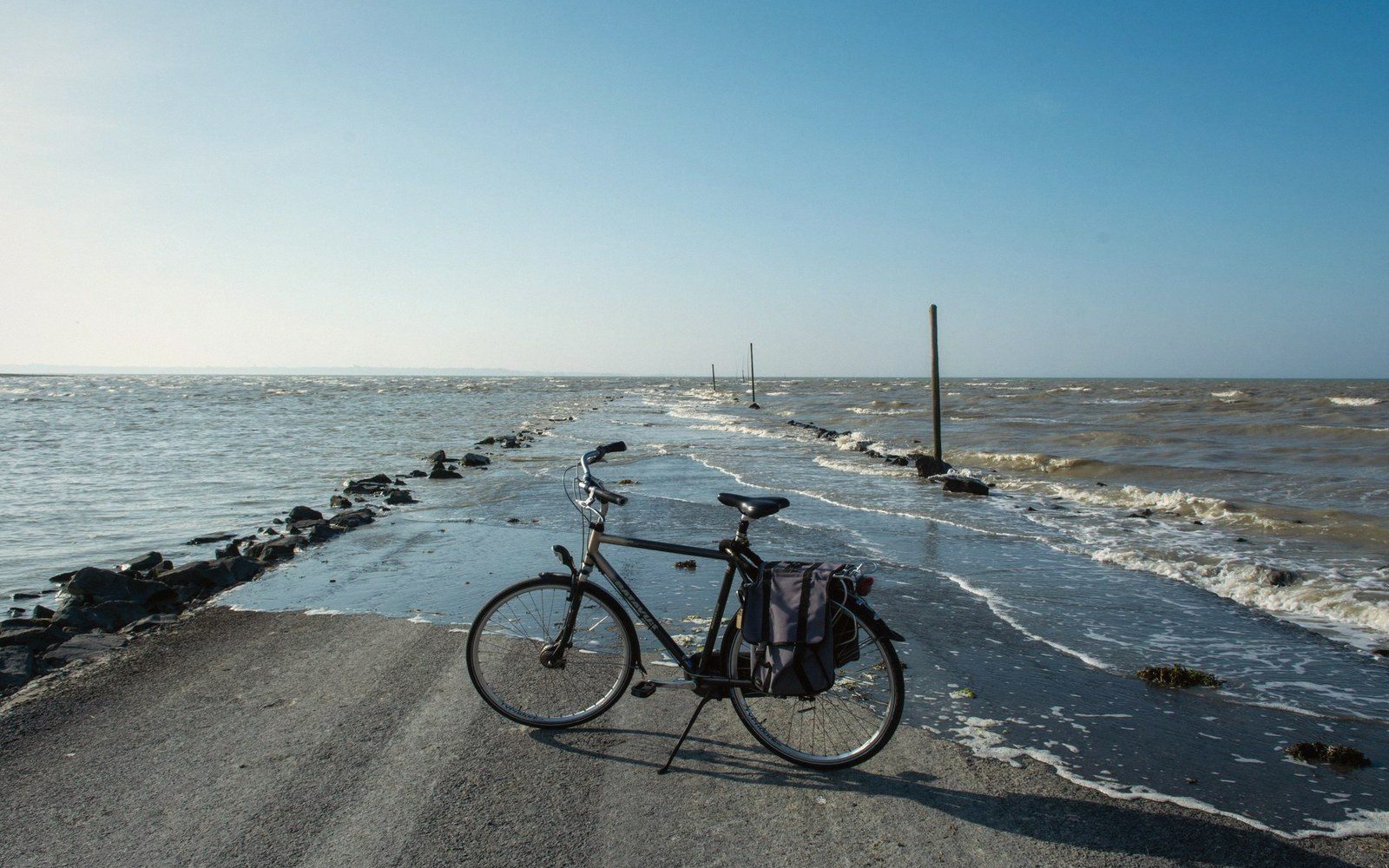
The Île de Noirmoutier and the Île d'Yeu sit offshore here, accessible by bridge and boat respectively. Noirmoutier has a salt-marsh economy and a causeway — the Passage du Gois — that floods at high tide and must be driven with timing. The causeway is worth knowing about not because it is dramatic but because it clarifies something about this stretch of coast: nature here is still running the timetable, and the flatness of the land means the sea can reach further inland than the map suggests.
The estuary crossings3 entries
- Loire estuarycrossed at Saint-Nazaire by bridge; marks the start of this route
- Gironde estuarycrossed by ferry (Royan to Pointe de Grave); no road bridge; ferry crossing resets the scale of the journey
- Adour river at Bayonneless dramatic but the landscape watershed between the Landes and the Basque coast
The Shift at the Gironde
The Vendée and southern Loire-Atlantique give way without ceremony to Charente-Maritime, and this is where the coast begins to soften. The town of La Rochelle is the pivot — it is a proper city with a medieval harbour, two defensive towers at the port entrance, and a very practised relationship with visitors that makes it simultaneously pleasant and slightly unremarkable. The old port is genuinely handsome. The arcaded streets in the centre are well-suited to rain. It is easy to spend an afternoon here and feel satisfied, which is not the same as feeling surprised.
South of La Rochelle the character begins to loosen. The Île de Ré, connected to the mainland by a long toll bridge, has cultivated a specific and protective identity — white-washed walls, hollyhocks, narrow lanes, a dress code for the bicycle that seems to be enforced by social rather than legal pressure. In July and August it is crowded in a way that tests any residual affection for it. In May or September it is genuinely lovely, the vineyards running close to the salt marshes and the light doing something different at each end of the day. The Île d'Oléron, larger and less self-conscious, sits further south and attracts less mythology and more family camping, which is its own kind of recommendation.
The landscape shifts again before you reach Royan and the Gironde estuary. The pine forest — the Forêt des Landes — announces itself here and then doubles down dramatically once you cross into the Gironde département. The estuary itself is the second great interruption of the coast, wider and more serious than the Loire, brown with tannin from the river systems draining the interior. The ferry crossing from Royan to Pointe de Grave is one of those journeys that resets the nervous system; there is no bridge, so you take the boat, and the crossing takes around twenty minutes during which you have nothing to do but watch the water and the low flatness of the southern bank appearing in the haze.
Pointe de Grave is the beginning of something genuinely different. The Dune du Pilat is well over a hundred kilometres south, and the road between them runs through dense Landes pine — flat, repetitive, smelling of resin, the trees planted in the nineteenth century on what was then a mobile dunefield and marshland. Occasional gaps in the forest reveal the ocean beach, always enormous, always cold-looking, the surf consistent enough that this stretch has been a surfing coast since the 1960s. The villages here — Soulac, Montalivet, Lacanau — are beach resorts that happen to be buried in a forest, which gives them an unusual quality: you arrive through trees and then the Atlantic opens in front of you at full scale.
How the landscape shifts (north-to-south sequence)In sequence
- Vendée/Loire-Atlantique
flat farmland, long sandy beaches, low dunes, domestic French resort architecture
- Charente-Maritime
softer light, salt marshes, Île de Ré and Île d'Oléron offshore, La Rochelle as pivot city
- Landes
130km of unbroken pine forest and surf beach; the emptiness is deliberate; 19th-century planting on former dunefield
- Pays Basque
hills, Basque architectural language (white walls, red/green woodwork), distinct culture and food
The Landes and the Turn South
Between the Gironde and the Adour river the coast is more consistent than almost anywhere else in France. The Landes — the pine-planted flatlands — run all the way south, and the ocean beach runs beside them without a break, occasionally interrupted by the mouths of small lakes draining through the dunes. There are no cliffs, no harbours worth the name, almost no towns facing the sea directly; the coast is a surf beach and a forest road and not much else for more than two hundred kilometres. This is not a criticism. The emptiness here is architectural, and the quality of the light in autumn, when the tourist infrastructure closes and the pine forest turns to copper, is something that a week on the Côte d'Azur will not prepare you for.
The Atlantic surf culture has its main French node here, particularly around Hossegor and Capbreton, where competitions bring professional surfers and the town centre has the slightly studied look of a place that knows it is being watched. The architecture around Hossegor is worth noting — a run of villas built in the 1920s and 1930s in what was called the Basque-Landais style, mixing Basque half-timbering with Art Deco detailing, that sits oddly but honestly in the forest clearings. These are not grand houses; they are summer houses that became a style, and they hold the period well.
South of the Adour, which bisects the coast at Bayonne, something decisive happens to the landscape. The flat Landes stops. Hills arrive quickly, the Atlantic pushing against the first folds of the Pyrenees, and the coast ceases to be a straight line. Biarritz is the name most people have, and it carries the weight of its own mythology — Second Empire resort, surfing capital, the high-water mark of a certain kind of French prestige tourism. The famous beaches are flanked by rocks and backed by a promenade with the Grand Hôtel du Palais sitting above it. It is neither overrated nor underrated; it is exactly as well-preserved and occasionally exhausting as its reputation suggests. Worth a morning. Worth leaving before the afternoon.
These are not grand houses; they are summer houses that became a style, and they hold the period well.
The Basque End
Below Biarritz the coast becomes something else entirely. The Basque country — the Pays Basque in French — runs the last thirty or so kilometres of the French Atlantic shore down to Hendaye and the Spanish border, and the transformation is immediate. The architecture changes: white walls, dark red or green painted woodwork, steeply pitched roofs with wide eaves. The language changes, or rather another language appears alongside French — Basque, which is unrelated to any other European tongue. The food changes. The hills behind every view become sharper. The light has a quality different from the Landes light a few kilometres north, warmer in tone, less diffuse.
Saint-Jean-de-Luz is the last town of any substance before Spain, a fishing port with a harbour that actually shelters working boats and a town square that functions as a town square rather than a stage set. The tuna catch still comes in here. The church where Louis XIV married the Spanish Infanta Marie-Thérèse in 1660 is still the parish church. The waterfront is not spoiled. It is the kind of place that justifies the long drive south.
The coast ends at Hendaye, backed by the Pyrenees, facing Spain across the Bidasoa river. Four hundred kilometres from the Loire estuary, and almost everything has changed: the geology, the vegetation, the architecture, the culture, the food, the pitch of the hills, the quality of the light. The autoroute misses most of it. That is the case for taking the longer road.