The Cities · Côte-d’Or · town and vineyard
Beaune and the Slope Behind It
A small Burgundian town with a famous hospice and the most coveted vineyard land in France beginning at the edge of the pavement.
Filed at
6A working town going about its day.
A small Burgundian town with a famous hospice and the most coveted vineyard land in France beginning at the edge of the pavement.
The Town at Ground Level
Beaune is compact enough to understand in an afternoon. The medieval ramparts still form a near-complete ring around the old town, and the streets inside them are narrow and unhurried in a way that larger Burgundian cities — Dijon is forty kilometres north — are not. Everything significant is close. The market square, the collegiate church of Notre-Dame with its choir tapestries, the wine trade offices behind discreet gates: you move between them on foot without consulting a map.
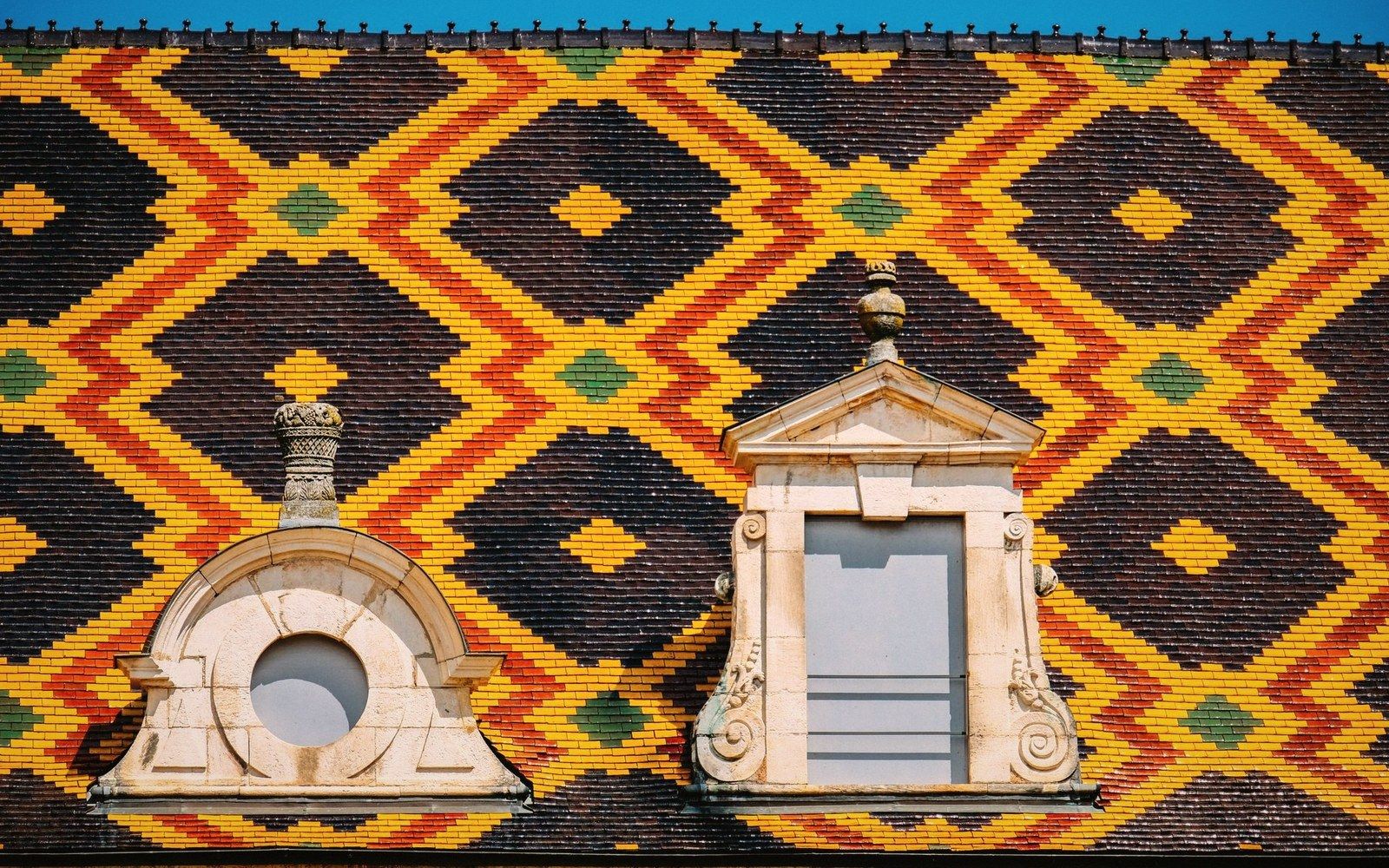
The Hôtel-Dieu stops most visitors in their tracks, and it earns the attention. Built in the fifteenth century as a hospital for the poor of Beaune and still functioning as a charitable foundation, it is one of the finest examples of Flemish-Burgundian architecture in France — the polychrome tiled roof alone, geometric and lacquered in four colours, justifies the entry fee. The interior courtyard is structured around a double arcade of pointed arches and wooden galleries, and at the far end of the grande salle, the original painted altarpiece by Rogier van der Weyden, a Last Judgement on polyptych panels, is displayed in a dedicated room with mirrors to let you examine the reverse. The Hôtel-Dieu holds a wine auction every November — the Vente des Hospices de Beaune — that sets a psychological benchmark for Burgundy prices, a ritual more than a market.
Outside the Hôtel-Dieu, Beaune is a working town with wine trade infrastructure threaded through it: barrel workshops, négociant cellars offering tastings, restaurants pitched at buyers on expense accounts and tourists who want to eat well. None of this is rough, but none of it is artificial either. The town functions.
ChronologyChronology
- Hôtel-Dieu founded 15th century as a hospital for the poor
- Rogier van der Weyden's Last Judgement polyptych painted for the Hôtel-Dieualtarpiece still housed there
- Vente des Hospices de Beauneannual wine auction each November, benchmark event for Burgundy prices
The Slope Above
Step out through the northern ramparts and within a few minutes you are standing in the vineyards. The Côte de Beaune — the southern stretch of the longer Côte d'Or — runs as a continuous band of vines along a gently inclined limestone escarpment, and the proximity of this landscape to the town is striking. There is no industrial zone, no ring road worth mentioning, no visual interruption between the last row of houses and the first row of vines.
The land divides into appellations that grow finer and more expensive as you move upslope and north: village-level wines from the flatter ground, premier cru parcels on the mid-slope, and the grands crus — Corton, Montrachet, Chambertin further north on the Côte de Nuits — occupying specific exposures that geologists and vignerons have debated for centuries. Burgundy's classification is granular to the point of obsessiveness: a boundary between a premier cru and a grand cru can run through the middle of a single field, and the price difference can be extraordinary.
Walking the GR route that follows the escarpment above Beaune — past Pommard, Volnay, Meursault — gives you the texture of the place rather than just the label hierarchy. The vines are trained low. The soil underfoot shifts visibly in colour and composition. Every parcel has a stone marker and a name. This is agricultural land managed with the precision of a laboratory but the patience of centuries, and it reads as landscape even to someone who has no interest in what it produces.
Beaune repays a day, maybe two. The hospice one morning, the slope the other, and something good at a table in between. That is what the town is for, and it does it well.
The hospice one morning, the slope the other, and something good at a table in between.